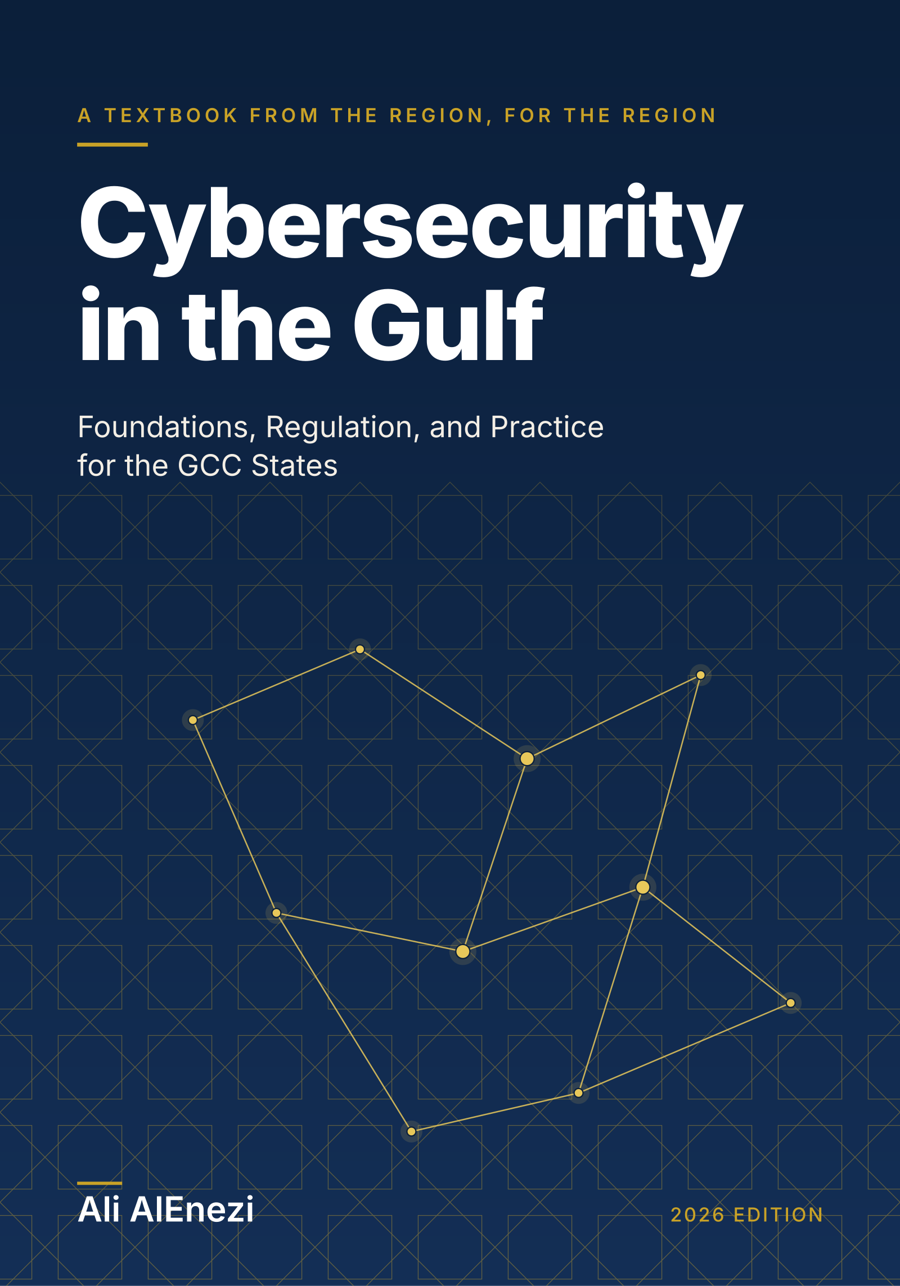
Where to buy
Paperback, 7 by 10 inches, and Kindle. The Amazon listing link will appear here the day the book goes on sale. The book is sold, not downloaded: nothing on this site or in the companion repository contains the text.
Why this book exists
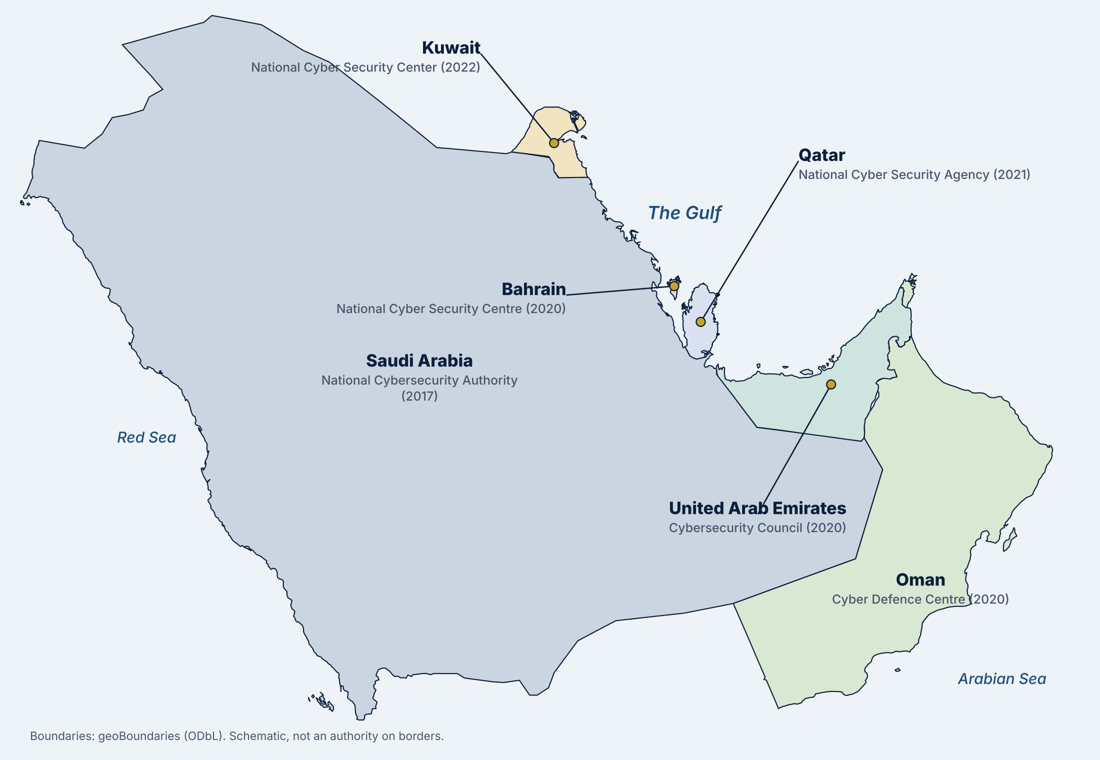
Every cybersecurity textbook in use in the Gulf was written somewhere else, for somewhere else. This one treats the six states of the Gulf Cooperation Council as a single cyber theatre: shared infrastructure that runs on desalinated water, exported energy and digital government; shared adversaries who have targeted the region since the Shamoon attacks of 2012; national authorities built within the same decade; and six legal frames that differ in the detail that decides what a security programme must contain.
It is written for universities, for government and for practitioners, and it is honest about where capacity is thin, where laws are incomplete and where the threat environment is harsher than elsewhere.
Inside the 2026 edition: twenty three chapters
Part I: The Gulf Cyber Landscape
The Gulf as a Cyber Theatre
Six states, one neighbourhood; the dependency stack of critical infrastructure; the six amplifiers that shape the region's risk; the digital transformation wave; what maturity indices measure and miss.
Threat Actors and Landmark Incidents
The adversary spectrum; Shamoon and its return; the Triton safety system attack; the Qatar News Agency incident; the hacktivist era from 2023 through the 2026 conflict spillover; ransomware and fraud; the pattern across all of it.
National Cybersecurity Governance
Three governance archetypes; the national authority, CERT, strategy and baseline of each state; a side by side comparison; the GCC ministerial committee, the Arab council and the international structures; how to engage the authorities.
Laws, Regulations, and Standards
The legal stack; cybercrime statutes; data protection regimes and free zones; national control baselines; central banks, telecoms, cloud and residency; international standards; the crosswalk method; the incident notification register.
Part II: Foundations with a Regional Lens
Principles of Security Engineering and Risk
Safety and resilience as security properties; threat modelling with a state aligned adversary assumed; risk management as a regulatory obligation; the design principles the region's incidents tested; the architect's role in a vendor heavy region; assurance within the cybercrime laws.
Identity, Access and National Digital Identity
The identity lifecycle in a high turnover workforce; authentication ranked by resistance to the region's fraud; privileged and third party access; the six national identity platforms and their shared architecture; federation; the fraud patterns and the controls that defeat them.
Cryptography and Trust Infrastructure
Building blocks; the global and national public key infrastructures; certificate lifetimes and Certificate Transparency; keys, hardware security modules and national cryptographic standards; a post quantum readiness programme.
Network and Cloud Security, Residency and Sovereignty
From perimeter to zones and zero trust; the services the region's adversaries attack most; the cloud regions of the Gulf; classification driven architecture under the national cloud and residency rules; operating cloud securely.
Application Security and Open Banking
The secure development lifecycle at the vendor boundary; OWASP standards as acceptance criteria; the open banking and open finance regimes of the six states and their shared trust model; interfaces; the software supply chain; national scale applications and vulnerability disclosure.
Data Protection and Privacy Engineering
From the laws' principles to engineering requirements; the data map and classification; technical controls; consent, rights requests, impact assessments and the officer; a cross border transfer decision method; breach handling within the clocks.
Security Architecture in Practice
The architect's job in a region that buys its systems; the principles the region does not negotiate; the review path with three artefacts and three gates; reference architectures; assessing vendor applications; the anti patterns that keep returning.
Zero Trust Architecture
What zero trust is and is not; why the region's incidents argue for it; identity foundation, device posture, policy engine, brokered access, segmentation and telemetry; a programme sequenced by consequence; the plant and the cloud; the measures a board can read.
Post Quantum Migration
The threat stated honestly; the 2024 standards, hybrid deployments and the 2030 and 2035 timelines; where vulnerable cryptography hides, ranked by lifetime; the cryptographic bill of materials as first deliverable; migrating transport, hardware, PKI, applications, firmware, payments and archives; governing the programme.
Part III: Sectors and Operations
Critical Infrastructure and Operational Technology
The industrial estate of the six states; how operational technology differs; IEC 62443 and the regional controls; the attack patterns that reached plants; the controls that matter most; incident response and cyber ranges.
Telecommunications and Digital Infrastructure
The operators and regulators; submarine cables and the Red Sea chokepoint; signalling abuse, fake base stations and SIM swap; registries, exchange points, routing and time; national network resilience; the operators as the region's security providers.
Healthcare Security
The six health systems and their national platforms; health data as the most sensitive category; the hospital as a cyber-physical estate; the Kuwait Ministry of Health case; insurers, laboratories and device manufacturers; what the pandemic applications taught.
Financial Services Security
Central banks and national payment infrastructures; the obligations of a Gulf bank; SWIFT, cards and instant payments; fraud as a social attack; cyber and operational resilience; sector cooperation as a control.
Government, Smart Cities and Digital Services
Digital government platforms and their shared architecture; secure by design; smart cities; securing events; procurement and vendors; trust in official channels.
Security Operations, Threat Intelligence and Incident Response
Operations engineered against the regional threat model; intelligence requirements and sources; brand protection from the certificate; the incident lifecycle with notification and communications tracks; exercises and metrics.
Offensive Security and Assurance
The legal frame for testing in the six states; the assurance ladder from scanning to intelligence led red teaming; scoping tests of applications, networks, people, sites, cloud and plants without harm; findings to closure; building the capability.
People, Culture and Workforce
Awareness that changes behaviour; insider risk in an expatriate workforce; national talent programmes and the universities' task; women in cybersecurity; ethics, law and research; leading security.
Part IV: Horizons
Emerging Technologies
Artificial intelligence on both sides of the contest; quantum in context; fifth generation networks and the Internet of things; space systems and navigation; a method for adopting technology securely.
Cyber Resilience and National Strategy
From compliance to resilience; the six national strategies compared; public private partnership; regional cooperation and harmonisation; the Gulf in the international order; the road ahead.
Appendices: a regulatory quick reference for all six states, a fourteen week course map, the open source companions used in the exercises, four instruments treated in depth (Kuwait's National Basic Cybersecurity Controls, Saudi Arabia's ECC-2:2024, the Central Bank of Kuwait's resilience framework and Qatar's National Information Assurance Standard), a chronology, acronyms, a research agenda for universities, a glossary and an index.
Drawn for the region
For universities
The book was written to be taught. Each chapter opens with learning objectives and closes with a summary, key terms, review questions, research exercises and link checked sources, and every chapter covers all six states. A fourteen week course map with learning outcomes is in the companion, and lecturers who adopt the book can request a question bank with answers and a lecture deck for every chapter through the repository. A research agenda for the region's universities is Appendix J.
Three readers
Lecturers and students
Each chapter opens with learning objectives and closes with a summary, key terms, review questions, research exercises and sources. The course map turns Part I into the first unit of a semester.
Officials and regulators
The governance and legal chapters and the quick reference describe every national authority, instrument and cooperation structure, written to be cited in briefings.
Practitioners
The crosswalk method and the notification register are built for reuse, and the companion tools compute deadlines, map frameworks and model plants.
Open companions
The exercises use open source tools built in the region and published on GitHub under SiteQ8, among them:
- Najjab, who must be notified and by when after an incident, across the six states and three free zones.
- Sadu, a register for the Central Bank of Kuwait's resilience framework with a crosswalk to international standards.
- Kuwait NBCC Toolkit, a compliance tool for the 2026 national baseline controls.
- Dir' and Mirqab, cyber ranges modelling a desalination plant and an LNG plant.
- KWTCyberWatch and QACyberWatch, phishing detection and brand protection from Certificate Transparency logs.
About the author

Ali AlEnezi is a senior security architect in Kuwait. He leads security architecture at the largest financial institution in the country, chairs the Cyber Risk and Security Committee serving Kuwait and the Gulf, served on the board of one of the largest information technology companies in Kuwait, and maintains a portfolio of open source security tools for the region, several of which are used in the book's exercises.
Cite and correct
AlEnezi, A. (2026). Cybersecurity in the Gulf: Foundations, Regulation,
and Practice for the GCC States. First edition.
The companion repository carries the course map, templates for the exercises, errata and the links to the open source tools. Found an error? The regulatory landscape changes every year; open an issue with the chapter and page, the sentence as printed, the correction and the official source.